


 Toutes les nouvelles de Cabotages en un clin d'œil ...
_2.jpg)


Your ad here


A friendly and local harbour
The small unofficial harbour of the post-war years sheltered around sixty boats. In the eighties, the creation of the outer harbour in the Narbonne seas enabled modern equipment to be installed and more depth. The current harbour can shelter up to 590 boats, mostly sailing boats, and its friendly atmosphere encourages regional users to come back there on a regular basis.

The oldest part of the first harbour in Narbonne dates back to 1948-50 and could only be used four months in the year because the canal would silt up.  The Racine assignment (1968) for developing the Languedoc-Roussillon coastline did not allow for a harbour to be built at Narbonne Plage, but with the boom in pleasure boats in the seventies, the local authorities decided to create an outer harbour in the sea that would be accessible all year round and would include the first dock. In fact, the Narbonne local authorities were to remain the owner and administrator of the harbour, and finance all of the work
that began in 1981 and lasted eight years. "We decided not to close the dock of the old harbour during the work. We worked on each side at a time, without blocking the access. This didn't seem to bother anybody; they were just too pleased to be getting a harbour soon that would be open all year round" explains Claude Hector, head of technical services at Narbonne Plage. The sea walls were extended from 150 to 200 m in 1981-82 and the pontoons were set up between 1987 and 1990.
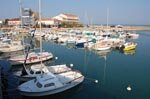 The harbour, which spreads over 7 ha of which 4 ha are basins with an average depth of 2.50 m, is primarily meant for pleasure boats, although as Bernard Hector points out: "If a fishing boat wants to stop there and shelter in bad weather, we let it" . At first, the local authorities planned for 400 berths in all, but nowadays, the historic dock can hold 120 boats and the new harbour 280. As for the canal at the back, 180 small excursion boats between 4 and 5 m long, can be sheltered there, which means that there are 480 spaces in all, 65% of which are used by 6 to 8 m long sailing boats. According to Claude Hector, "half of the users, who are very loyal, mainly French and from the region, come in particular from the Narbonne area. Then there's the people from Toulouse and Albi. They like Narbonne Plage because of its friendly and family environment".
The harbour is open all year round, and is obviously busier from March to October. Sailing is the main activity but there are others: cruises, fishing trips and diving excursions are offered by three water sports clubs in the resort. Although the number of boats is increasing and the local authorities plan to extend the harbour in the next decade " Narbonne Plage remains a friendly and local harbour" insists Claude Hector.
Saint Pierre
the port without any ancestors
From the Iron Age to the fall of the Roman Empire, which amounts to at least a thousand years, Narbonne was one of the great ports of the Mediterranean and thus of the Western world.
Archaeologists are not certain of the configuration of the ports that were established here subsequent to the regular invasions of the Midi.
For a long time, it was not a port such as we think of them today. The "Histoire de Narbonne" (published by Privat) refers to "a series of unloading docks connected to the city by the river route and its navigation".
It must be remembered that the coastline has changed considerably over the centuries and that the Aude River has changed course.
Ancient texts lead us to understand, and it was quite likely so, that deep-sea ships did not sail up the Aude River. Rather, large ships remained at anchor off the coast and goods were transferred onto barges that could travel up the river as far as Narbonne. Port la Nautique, on Lake Bages, was a very active point of arrival.
There was intense goods transport along the coast but, for the moment, we have no proof of a deep-sea port. Saint Pierre de Narbonne may thus not have any ancestors...


