


_2.jpg)


Your ad here


A strange port where the winds of change are blowing
Balaruc is not your standard layover. Balaruc les Usines is the port of the three Balaruc “towns” and has, shall we say, an unusual charm and an interesting history which is far from over yet.

The Sète canals are a splendid way in to the Bassin de Thau for sailors who are not intending to take their masts down and head inland down the canals. A “royal” city cruise, although you can only sail down the Canal Royal if your mast clearance is less than two metres.
Nevertheless, for those who can do it, crossing Sète in a boat is a real treat! You need to go down the sea canal, wait for a short while in the Bassin du Midi, and then take the link canal…going through the bridges that turn, pivot and open just for you. There is even a railway bridge where you could almost believe that the TGVs stop to let you through. The opening times transmitted by the harbour master on VHF radio channel 12 must take the train timetables into account...In Sète, nothing is commonplace.
STOP OFF AT LA POINTE COURTE
Next you need to stop off at La Pointe Courte, which is a world of its own. It is a small residential area which in any normal town would not be p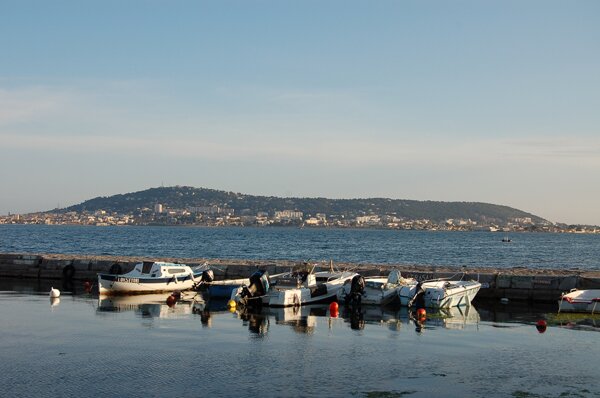 articularly desirable - it is overlooked by a main road to the south and a railway where trains pass night and day over an iron bridge, and has a view over factories and wetlands of the lagoon to the north-east. But Sète is no ordinary town and La Pointe Courte is a wonderful place to visit. It was made famous by Agnès Varda who named her first film after this place in 1955. She filmed with Sylvia Montfort and Philippe Noiret and the town then returned the favour by naming a street after her.
Along the canal, you can moor up (watch out for the deep water next to the jetty and the current which is often strong) and get your morning cup of coffee in the Bar du Passage where you will find photos of the film shoot. Take the opportunity to go and see the little fishing port of Nacelles on the other side. Boats, nets, huts… it’s like something straight out of a book. La Pointe Courte started life as a fishing village.
A NEW WORLD
Balaruc ahoy! The entrance into the lagoon via the Etang des Eaux Blanches between La Pointe du Barrou and La Pointe de Balaruc is just as spectacular. Between Sète’s Mont Saint Clair with its backdrop of wooded hills and Cap d’Agde’s Mont Saint Loup, this is a magnificent place.
Ahead, the Roquerols turret rises out of the shallows which surround a promontory where Balaruc-les-Bains is located. Head straight towards the turret, and then pass to its left or right to go to either Bouzigues or Mèze. To get to Balaruc you ne ed to take an eastward heading straightaway and follow the signposted channel which joins the Rhône-Sète Canal.
On the left bank of the channel, you can see the jetties of Balaruc-les-Bains, from where you can visit Balaruc-le-Vieux.
Balaruc-les-Bains is the second-largest French thermal spa, with nearly 2000 tourists a day. And that’s been the case, ever since the Gauls of the Roman era discovered the 40° hot spring, mixed with sea mud, which is excellent for rheumatism.
Balaruc-le-Vieux, not far away by bus is an old fortified medieval village built in the round, which seems almost untouched by modern life. The citadel overlooks the Bassin and the view from its walls is superb.
On the right, you can see the factories on the other side of the Etang des Eaux Blanches, in particular an old half-abandoned cement factory, all separated from the Bassin de Thau by a narrow kilometre-wide strip. Behind that is Balaruc-les-Usines where the port is.
A PROPER PORT ONE DAY?
The Balaruc-les-Usines port is a strange one. But first we need to explain its history, and why it is a little different. This part of the Bassin de Thau, the Etang des Eaux Blanches, belongs to the 'Raffineries du Midi' oil company. This huge oil refinery and storage business set up here at the end of the 19th century, had a pool of between 5 and 6 m deep dug and marked out an access channel from Sète. Its operations closed down in 1990. Since then yachting use has eaten into the refinery’s harbour slowly but surely, but without any overall planning. The area has basically turned into a free port, a self-managed boater's squat, with no harbour master, no running water, electricity or jetties and, therefore, no duties or fees. The Balaruc les Bains amateur fishing association was formed in 1996 and has added its efforts to those of the sports association to try and make legal mooring rates apply, at least temporarily, in order to manage the «port», and start cleaning it up. The need is urgent, because when the mud on the bottom is disturbed, oil rises to the surface and threatens the whole Bassin. The risk is considerable, since there are 250 boats anchored there at the moment with an array of anchors, stakes, gangways and abandoned hulls behind a floating barrage which is not pretty but has managed to contain the layer of pollution since 2007.
But how long much longer will it continue to hold? If you think how important water purity is for the economy of the Bassin that basically lives off shellfish farming, pleasure boating and tourism, this 'dirty' zone is a time bomb waiting to go off.
But don’t be put off. The port has its own special charm, and in a few years it will likely look entirely different, as the new residential blocks that have been built around the port suggest. We just need to be patient!


