


_2.jpg)


Your ad here


A sailing tour round the bay
Take a short cruise around the sea-marks in the bay.

There's a whole world to discover in this small bay. The area is highly regulated due to car ferries and military activities, but it is a lovely stretch of water for a gentle day's sailing. There are so many different views to catch, if you want to drop anchor for a bit.
SAINT MANDRIER NAVAL BASE
 Quarantine and naval training centre
Across the bay from Toulon, convicts were put to work to build the Saint Louis hospital in 1670, a holding facility for crews whose ships were quarantined. The building continued to serve as a hospital until 1936, when it was converted into a naval training centre. The Saint Mandrier base is now France's biggest naval training centre, on a site of 80 ha (200 acres).
BAIE DU LAZARET
 Shellfish farming, old style
It seems odd to see these strange old huts on stilts in the middle of the bay, with mussel farms that seem to date from an altogether different era. They seem out of place next to the warships that sometimes pass by. You might think that the mussels might suffer from pollution, just as they did when the fleet was sunk in 1942. But, when you think about it, mussels are a good marker of the state of the marine environment. If the health authorities declare them fit to eat, well…
CORNICHE MICHEL PACHA
 Take the coast road
If you take a trip along the coast road around Baie du Lazaret, you will be rewarded with great views. You see back over what is, for yachts people, the hidden face of Cap Sicié, but also the wooden slopes of Pin Rolland and the stilted huts. You can easily spot the road, if you are anchored in the little bay (be careful of the bottom, and check whether you need a permit!). It is part of an urban development project that is the brainchild of Michel Pacha, former Mayor of Sanary, aiming to redevelop the area, in particular the isthmus and the route from La Seyne sur Mer to Les Sablettes. The success of the project is shown by the number of smart villas built in the area.
FORT BALAGUIER
 The King's riposte to the pirates
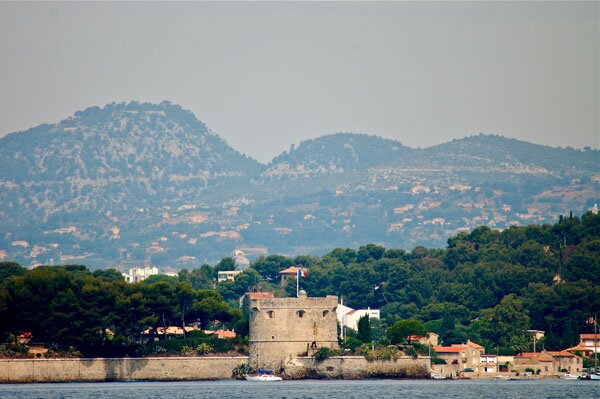
Pirates! They were the scourge of the Mediterranean coasts. Not only did they terrorise the popular mind, but they posed a real danger, and the authorities need to keep on protecting their citizens with fortifications, watchtowers and cannon posts. The fort on the Balaguier headland was built under Louis XIII by order of Cardinal de Richelieu. The tower faces the Grand Tower on the Pipady headline, which had been built the previous century, and completed the defences for the bay. The defences stood the test of the pirates, but were later founding wanting. They were not restored in Vauban's works under Louis XIV and proved to be of little use against the sieges the town was to face.
VIEUX CHANTIERS DU MIDI
 Forerunners of the naval industry
The 'Vieux Chantiers du Midi' were the ancestors of La Seyne sur Mer's shipyards, a reminder of the early days of shipbuilding, which started in 1711, shortly after the great siege of Toulon in 1707. Ships and boats, big and small had to be rebuilt after so many had been burned and sunk. The 'Chantiers du Midi' yard never built really large vessels, focussing instead on trawlers and yachts. Some of its boats remain, a beautiful testimony to an age gone by.
L'ÉGUILLETTE
 A third watchtower for Toulon
Alongside Fort Balaguier and the Grand Tower of Pipady, the third element of the coastal defences can be found on the Éguillette headland, guarding the bay in the time of the Barbary pirates. The fort here was built in 1680 on the headland that is only 0.8 nautical miles from the Pipady headland opposite, meaning that the two towers could monitor the mouth of the bay, and cover it with crossfire if needed. Although insufficient to defend Toulon against a well-armed, powerful enemy squadron, this triangle of watch posts provided an excellent means of deterring the pirate ships, at least.
LE BRÉGAILLON
 Toulon's commercial port
Le Brégaillon is Toulon's industrial and commercial zone. To give you an idea if the importance of this port, in 2005, nearly one million tonnes of goods were routed through here and one million passengers embarked or disembarked. The area was previously a dormant shellfish farm and has now been converted into a terminal with one 215 m (700 ft) dock and a second 240 m (790 ft) dock.
THE GRAND TOWER
 They should have heeded Vauban…
The Grand Tower on the Pipady headland was the first watchtower in a series of anti-pirate defences. It was built under Louis XII, completed in 1524 and known either as the Grand Tower or the Royal Tower. Modernisation work took place a century later, fitting the tower out with 22 cannons, contemporaneously with the construction of the Balaguier and Éguillette strongholds. Under Louis XIV, the architect Vauban asked for the defences to by 'brought up to standard' in the light of modern warfare techniques. Nothing was done, and the forts retained their rather 17th century style.
BREAKWATER AND TORPEDOES
 Halting storms and speeding motorboats
The long breakwater marks the end of what is known as the 'Little Bay'. Three long structures were built at the end of the 19th century. The largest, a full mile long, ends with a little lighthouse that greets sailors as they enter or leave Toulon. The breakwaters are there to slow down boats, but mainly to break the swell whenever there is a south-easterly wind. The base contains the 'torpedo fort', which was where torpedoes were tested in the post-war years. Things have quietened down now that other means have been found for the tests. The fort is a large flat, raised area with a sea view, in order to watch the missiles' path.
FORT DES VIGNETTES
 Heroics during the 1707 siege
This fort, which is now known as the Saint Louis fort, was built shortly after the Éguillette. It provided a more modern addition to the 'anti-pirate' defences. The aim was to defend the Vignettes cove, which could have provided shelter for enemy ships. During the 1707 siege (see article), this fort's artillery and the courage of its men played a key role in preventing the Anglo-Austrian and Savoyard coalition from taking Toulon. It was almost totally destroyed, but was rebuilt almost identically and renamed the Saint Louis fort.

