Navigation
Méditerranée

Navigation
Diaporama
Navigation



Banyuls-The disadvantage of being in a strategic position
Banyuls has played a major role throughout history due to its strategic location. Occupied by the Phoenicians, Romans, Visigoths, Saracens and then the Franks, Banyuls was directly affected by the numerous wars between France and Spain. The last disaster to hit the town was a dreadful cholera epidemic.
Certain geographic locations are predisposed to go down in history, or on the other hand to bear the consequences. This is indeed the case of Banyuls. The first traces of human activity go back to the Neolithic period. Near to water but sheltered from the wind, these prehistoric civilisations left their marks, such as for example the dolmen on the ‘Creu’ col with its engravings or the ‘Cova de l’Abarb’ dolmen.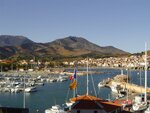
When the first Phoenician settlers arrived in Collioure in the 6th century B.C., they traded with the Ibero-Ligurian tribes (pre-Celtic tribes) who were living in these parts. Then it was the turn of the Romans. They colonised the land around 200 B.C. They developed agriculture and trade, and built roads. The most famous of these is the Via Domitia. It went through Salses and then dropped to Elne where it separated in two. The main inland route crossed Le Boulou, Les Cluses or the Perthus col, whereas the coastal route crossed the site of Banyuls, which had very few inhabitants at that time. Proof of the passage of Roman troops can be seen by the burial place of a 10th Roman legion officer at the foot of the Madeloch Tower. Taking advantage of the decline of the empire towards 400, the Visigoths founded the Goth kingdom in Toulouse, thereby creating another flow of trade with the Roussillon region. They were followed by the Saracens and then the Franks … invader after invader, Banyuls finally went down in the history of the Christian Western World of the Middle Ages.
 Christianisation led to the construction of large monasteries and chapels as early as the 9th century. These Holy Places attracted people in great numbers. This marked the true beginning of Banyuls.
As soon as land was recovered thanks to the victory of the Franks – Carolingians over the Saracens, the first inhabitants built a chapel on a small rocky hillock near to the sea. Official documents referred to this place as Banyuls as early as 981. The name Banyuls, which was derived from the word "Bain" (Balnoneum), means a lake. The Banyuls plain was very marshy at that time. In 1774, the place was referred to as "Bagnols del Maresme" in documents.
The Knights of the Temple drained the plain in the 13th century. The monks of Saint Peter of Rodes took over when the Order of the Knights Templar was disbanded. Fishermen built the first wooden houses by the sea and during the 18th century more solid constructions made from stone and lime were added. About thirty households took up permanent residence in the area, forming a new site.
Then, like all the villages in the region, Banyuls endured the constant Franco-Spanish wars, and in particular the war which took place at the end of the 18th century. The village, which was very close to the border of that time, was directly affected by the attacks from the Spanish and then by the counter-attacks from the French. Banyuls was never able to defend itself as it had no walls, like Collioure or Argelès, its neighbours.
The war, which can be considered for all intents and purposes as a plague, was followed by the cholera. The deadly illness devastated the region in 1832 killing hundreds of people. The inhabitants organised a procession to ward off the evil disease on Saint-Sebastian’s Day, who was said to have protected Pavie and Rome from the plague. The saint and martyr pierced by arrows was also said to be the Christianisation of the god Apollo, who was called Apollo by both the Greeks and Romans. He was the archer-god of healing and medicine, and in particular the plague. Come what may the cholera epidemic lost ground. In gratitude to the saint, the inhabitants have maintained the procession to this very day.

