Navigation
Méditerranée

Navigation
Diaporama
Navigation




Bouzigue-Listen to the marvellous story of the port
The development of the commercial port of Bouzigues began in 1670 and the first ship docked there on 15 May 1702. The current-day port is the result of a succession of four distinctive stages. Over the years, the commercial port was transformed into a fishing and shellfish port and into a marina due to the boom in oyster and mussel farming and river tourism.
 The founding of the port of Bouzigues in exchange for… an annual allowance of two chickens. This is by no means a joke. "The inhabitants of Bouzigues, who were somewhat jealous of Cette, wanted a port. It naturally had to be smaller as funds were limited", explains Jean Brel, co-author of the book ‘Raconte-moi, Bouzigues’ who adds, "in 1670 Timothée de Geoffroy gave the commune a plot of land to build its first port. By way of payment, Mr de Geoffroy was given an annual allowance of two chickens which he received from the hands of the consul on 15 August (the Feast of the Assumption)." In 1687, an official report stated that this square was to be used in the future in exchange for a white carnation.

Stage 1: 1671. The wall, whose foundations were used as the first quay, was built. It was later pulled down and replaced by the balustrade on the ‘place du Général de Gaulle’ (which was formerly known as ‘place du port’ - Port square). All the inhabitants of Bouzigues took part in the building of this quay. The rich provided the material and livestock while the poor laboured. They had to dig 80 meters deep to be able to accommodate boats. Empty or full wine barrels and casks transited through this new commercial port. However, the quay as it stood then was not protected from sea winds.
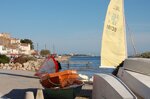 Stage 2: 1682. Bouzigues began building two piers in the east and west which were extended and reinforced ten years later. The prolongation of the dyke gave rise to the skiff port (small boats without mast or sails which were used for fishing). At the same time, ‘foudrier’ (cooper) workshops were built at the place called "La poterne".
The date of 15 May 1702 and the berthing of the first ‘vessel’ in the port is a landmark which is remembered by all the inhabitants of Bouzigues. "As it was the first time that the inhabitants had seen a boat of this kind, a celebration was organised and the captain received a ‘muid’ (600 litres) of wine," explained Jean Brel.
 Stage 3: 1820. New work was undertaken by the Town Hall: the former port was filled in and land reclaimed from the lake. This represented a financial godsend for the commune. It auctioned off this land to individuals and companies who built warehouses and tun factories (50 to 600-hectolitre casks). The municipality invested the profits gained from the auctions in work on the new port. The arrival of metal and cement vats on the market resulted in the end of the tun factories. The plots of land were sold for housing. Stilt houses can still be seen on the land today.
Towards 1840, the piers were once again extended. This marked the end of major work on the port.
The port of Bouzigues has evolved. Initially, at the beginning of the 20th century, shellfish farming and fishing replaced commercial activities. After the 2nd World War, this represented a new stroke of luck for the commune.
 Stage 4: 1975. The rise in popularity of pleasure boating in the 70s demanded large-scale cleaning (1.5 to 2 m) of the water in the port to be able to accommodate this new type of craft. The marina was officially inaugurated in 1975 and is today able to offer 80 berths. The west pier can accommodate approximately ten penichette barges. Bouzigues is an exquisite small port which is much appreciated by fresh water sailors. As they pass from one canal to another they like nothing better than placing their flat-bottomed hulls in the salty Thau lake.


