Navigation
Méditerranée

Navigation
Diaporama
Navigation




Hyères-Hyères les palmiers
Profusion of colours, profusion of follies
Hyères was of course a prehistoric site, ancient village, a stronghold belonging to Massalia (Marseilles), a Roman port, and market town from the middle ages… Traces of these eras can still be found, remains, ruins, monuments here and there which remind us of the history of the City of Olbia which goes back in time before the road building Caesars and continues well after the fort-building Kings of France. Hyères is especially renowned as a 19th century town.
 As the portside bus passes the train station and the Via Olbia roundabout, what is most striking is the feel of an Offenbach operetta. It is as if twenty-five centuries of consecutive civilisations have been swept away on the peninsula, leaving nothing but the outmoded but ever-present Second Empire, Third Republic, chic 19th century architecture.
Walk back up Avenue Gambetta. Although the palm trees hide the bourgeois properties from view, you cannot miss the temple of shopping, the Dames of France, Hyères' answer to the Galeries Lafayette in Paris. Hurry past the Macdonald's sign, to examine this big glass-fronted meringue, built by Pierre Chapoulard in 1884. In a sign of the cosmopolitan prosperity of the period, one department in this store offered "fully furnished villas" and "interpreters in all languages".
These advertisements say it all. Under Napoleon III, Hyères built villa after villa, the big names of the day from all over the world came running.
But what made the fortune of this sleepy little town of 6,500 inhabitants, with no commercial port, no business, no industry, no shipyards, no navy or any other revenue along the lines of that which filled the coffers of larger cities like Toulon or Marseilles, or smaller towns like La Seyne?
 The very fact that there was no industry was actually the key to the town's growth. Wealthy industrials who made their fortune elsewhere came to enjoy the idyllic and beautiful spots with an appreciable climate, where they could meet together, spend their money on carefree pleasures, and pamper themselves. Empress Eugenie had initiated the trend of sea-swimming, and thermal bathing, along with the casinos, became the principal social pursuits. Hyères started to become a seaside attraction served by the Paris-Lyon-Mediterranean train line. The road from the station to the town centre runs down a palm tree lined avenues. You won't find the plane trees that are ever-present in many Provençal towns to provide shade for the boules players. Here, one did not play pétanque as in La Ciotat, one played golf, as in England. One would enjoy a stroll along the promenade, aiming to see and be seen.
And while we're on the subject of the English … After three futile attempts to take possession of Toulon by establishing naval bases in the Hyères bay, the English returned in their hordes. By 1860 they accounted for 25% of the population. With the arrival in 1877 of the English Naval hero Captain Corbett, famous for his exploits in the Napoleonic wars, with British high society in tow, even Queen Victoria, built three large hotels: the Ermitage, Albion and Costebelle. An almost disneyesque Neo-Gothic Anglican church was consecrated by the Bishop of Gibraltar in 1884.
The most elaborate and eccentric architecture flourished. Architect Pierre Chapoulard, who had designed Dames of France, also built himself a villa composed of an indescribable patchwork of styles, which would be equally fitting in Strasbourg, Vienna, Nice or Montparnasse.
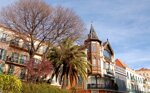 Alexis Godillot, a local version of Baron Haussmann (the architect famous for his work in Paris), mapped out streets, built public monuments and designed new districts. In accordance with their pleasure and fantasies, the rich built Moresque, Greek, Roman and Andalusian villas. Genuine chateaux sprung up too, such as San Salvadour, a magnificent work from the Fine Arts Academic period. The Parisian School of Fine Arts ran competitions for the design of luxury 100 bed-roomed hotels with 200 place dining rooms, a succession of sitting parlours, and a winter garden.
The high season ran from October to May. Thereafter the climate was considered far too hot. The fashion for jam-packed beaches had not yet come in, neither had the crisp-fried perma-tan look. The aim back then was simply to spend a clement winter in good company.
Then, one day, the wind turned. The English upped and left for Cannes and Nice, where the northerly wind blows less cold and where they could moor their luxury yachts. The glories of Hyères started to fade somewhat but her extravagant houses, her palm and orange trees and her colourful streets remained.
Once you have safely docked, jump on the tour bus for a trip round this charming town.
- Christophe Naigeon


