Navigation
Méditerranée

Navigation
Diaporama
Navigation




La Ciotat-La Ciotat and its shipyards
La Ciotat has always been on the cutting edge of shipbuilding, from the 17th century until the 1980s, with the first motorised boat and the first paddle steamer. After a crisis, the site has more recently been converted for use by the yachting community.
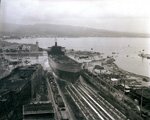 So many boats were being built by La Ciotat's fishermen and sailors, that the town council felt regulations were needed. An order issued in 1622 provided that shipbuilding activities only to carried out at the Escalet site. La Ciotat had highly skilled craftsmen, the envy of the King's own men. The port itself was very active, with sixty ships by the end of the 17th century, including a 40-cannon frigate, the 'Ville de La Ciotat' (1779). La Ciotat boasts that it built the first steamships, which revolutionised sea-going transportation. The Royal Ferdinand entered the old port in 1818 - whilst Marseilles still had no steamers in its fleet by 1830.
La Ciotat's industrial future was transformed by a townsman, Louis Benet who in 1835 founded a shipyard to build timber ships with a 250 to 600-tonne capacity. At the same time, he fitted out a steam engine workshop and, in 1846, completed the first French steampacket that served on the Levantine line. It was the Phocéen, a 339-tonne, 46 m (150 ft) long steamer.
Between 1842 and 1846, the shipyards produced nine huge iron steamships, including the Bosphore, whose propeller turned at more than 150 rpm. King Louis-Philippe ordered the Narval, one of the first nationally-owned paddle steamers built in France. The 1848 revolution cut this success short, sparking an economic crisis. 800 labourers were made redundant by the Benet shipyard.
Under Napoleon III in 1851, France entered into a new contract to set up postal services from Marseilles to Malta, Constantinople, Alexandria and Greece. Armand Béhic, a financier, took the opportunity to purchase the struggling Benet company to found his own shipbuilding concern in La Ciotat. The end of an era of sailing ships had been the key to Benet's success, and the end of timber ships was the opportunity Béhic's company needed.
English engineer Barnes from the old shipyard passed away in 1852. His last ship, the Pericles, was launch on 21st May of the same year. It set a new record for length at 53 m (175 ft). Armand Béhic then turned to engineer Stanislas Dupuy, who built the Danube two years later, the company's first propeller-driven ship. It was 77 m (250 ft) long, and weighed in at 1,200 horsepower.
From 1916 onwards, the shipyards turned to maintenance of the postal service fleet and building new units. At the end of the First World War, the shipyard site covered 14 ha (35 acres), with 3.5 ha (8 ½ acres) indoor floor space, where 2,300 staff worked. They had the capacity to build two 150 m (500 ft) ships at once. Mérope, the first oil tanker, was launched on 7th May 1922. However, Marshall Pétain, civil aviation controller for the new State enterprise, Air France, feared the competition from the postal messaging service and refused to renew its license.

In 1940, the yard was taken over by Jean-Marie Terrin and renamed Chantiers Navals de La Ciotat. Despite starting out in the midst of wartime, the C.N.C. shipyard modernised its production facilities and improved its work rate. It produced huge ships, like the supertanker Al Rawdatain that first sailed in 1970. It was 357 m (1,170 ft) long, 57 m (187 ft) wide and 29 m (95 ft) deep, with a tonnage of 332,000 t.
But the 1970s oil crisis did for the shipyards. The last ship, the Monterey, set sail in 1987. It was a time of crisis for La Ciotat, marked by strikes and redundancies.
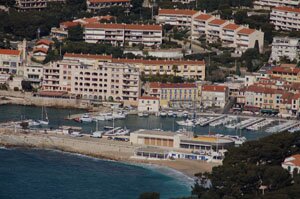
Whether through nostalgia, lack of funds or the hope that things might one day turn again for the better, the town decided to keep its docks and cranes and some of its equipment. Time has proved that to be a wise decision. If you take a stroll through the old town, you will see that there is work going on again around the docks. Maritime businesses now employs around 600 staff on a 20 ha (50 acre) site. Maintenance of luxury yachts has taken over from industrial shipbuilding, enabling La Ciotat to keep its working-class seaside atmosphere - a refreshing change from the bourgeois Riviera.

