Navigation
Méditerranée

Navigation
Diaporama
Navigation



La Ciotat-Pudding, taxes and miracles
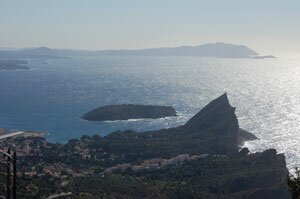
Sailing into La Ciotat takes you along a very beautiful stretch of coast. There is plenty to catch the eye, the unusual Bec de l’Aigle rock formation, the greenery of the little island, the cranes around the docks and the town's bell towers.
ILE VERTE AND BEC DE L’AIGLE
 If you approach La Ciotat from Marseilles, you will have sailed past a series of stark, white, treeless islands. Once you have passed the Bec de l’Aigle (eagle's beak) cliffs, you are struck by the sight of Île Verte (green island), whose name is well merited. It's the only island on the Provence coast with trees on it. See if you can find anchorage in the little bay on the northern side, and take a walk to the island's high point. On a clear day, you can see the mountain ranges to the north, and there is an orientation map to help you identify them.
 Another curiosity is below your feet and right in front of your eyes. It's a pudding - puddingstone, to be precise, the conglomerate material from which the Bec de l'Aigle and Île Verte are formed. It consists of a sandstone pudding 'dough' with pebbles for the raisins. Alluvial material was deposited by a river that must have flowed here around a hundred million years ago, and this material accumulated and was compacted together, forming a kind of natural 'concrete'. This unusual composition has allowed weathering by the sea, rain and wind to sculpt out shapes rather like the sand hardened on a beach.
BÉROUARD STRONGHOLD
As you enter La Ciotat's old port, you sail past a red lighthouse, which has no particular historical interest. The green lighthouse, however, has an attractive metal superstructure, and a bit of a history behind it.
The stone pier on which it is built is called Bérouard, a deformation of an Old French word for a stronghold. The pier, which was completed in 1840, is an extension of the platform of the fort, already three hundred years old by then.
Construction of the stronghold began in 1551 and took thirty long years. A special 20 % levy had to be taken on "the fruits of earth, namely wheat, barley, oats, wine, saffron and figs, and any earnings from the sea". It was a forerunner of today's VAT! Artillery guns were added to the fortress in 1564.
The La Ciotat museum has a watercolour showing the openings that housed the eleven cannons. The bottom of the stronghold was a dungeon that was filled with political prisoners during the Revolution.
By 1854, the Bérouard stronghold was being used exclusively as the town gaol, before being closed down in 1889 and demolished in 1895, to create more space for the shipyards.
As you pull into the port, take a look at the old lifeboat, a homage paid to the tireless services and lifesaving efforts of its crews.
EX-VOTOS AT NOTRE DAME DE LA GARDE
Before there were lifeboats, seamen did whatever they could to help each other out. Many of them also looked to the heavens for help in times of trouble, and thanked the Virgin Mary if they came through. The survivors often showed their gratitude by donating ex-votos, little paintings that depicted the storm, rescue or shipwreck they had lived through. Fishermen also came to offer thanks for miraculous catches.
These paintings are often very simple chronicles of everyday life, providing us with a wonderful historical record.
This is how municipal records describe one of the ex-votos: "The painting of La Baleine, dated 1808, shows the storm that hit the ship off the 'Barbary' coast, with lightning striking the ship's mizzen-mast." The likelihood is that one of the mariners was a La Ciotat man, who felt drawn to offer up thanks after a miraculous rescue.
 A second painting shows an Anglo-Spanish privateer being towed into La Ciotat on 15th June 1799. The previous day, this ship had captured three boats from the La Ciotat fleet. The town council had therefore appointed fishermen Antoine and Désiré Cuzin to deal with the raiders. After a three-hour chase off the coast of Cassis, an exchange of musket fire ensued. A few moments later the sail and Union Jack were lowered and raised as a sign of surrender. The Cuzin brothers brought the three captured ships back into harbour at La Ciotat to rapturous acclaim. The Court of Marseilles recognised the booty as "spoils of war", and the Cuzin brothers received 194 francs, with 48 francs 72 for each of their crew members. One of their sons later had an Ex-Voto produced in 1831 in memory of the exploit.


