Navigation
Méditerranée

Navigation
Diaporama
Navigation



Marseille-MPM, the lord of the rings
Transparency in the harbour’s waters
“Is it a reform? No, Sire, it’s a revolution!” we could say to plagiarise the Duke of Liancourt’s answer to Louis XVI on the eve of 14th July 1789… What is happening in Marseilles is more than just a change; it is a tidal wave in the waters of the Old Port. And hardly a tall story.
 When we read in “Marseilles, European capital of pleasure boating”, the official review of the MPM (Marseilles Provence Mediterranean Urban Community) that “an agreement setting out the undertakings of each party involved is now essential to ensure a perfect harmony and transparency in the collective use of the lakes”, we get the impression that the restrained wording hides a hammering of fists on tables. On Quai Rive-Neuve, they’re translating the typical Marseilles slang: “Mèfi, fini l’engaste…” (Look out! The excitement’s over…)
Think about it: for the sake of “tradition”, everybody – individuals or organisations – considering themselves as depositories of mooring ring(s) could rent, transfer or sell their ring, as they pleased, without any formalities, signatures, or declarations. In other words, without right. Thus, amateur sailors were being asked for ten or fifteen thousand Euros to become no more an owner of the berth than the transferor was.
Here, the expression “spaces are dear” had taken on its full meaning. With the boom in pleasure boating, and the system of supply and demand working with all available means, rarity had become the norm… and dearness the law. There were some, like this old fisherman, who claimed: “my old fishing boat is worth two thousand Euros. If I sell it with the berth, it’s worth twelve or fifteen. So…”.
But there were others who cheated with much more premeditation, like this tenant (untitled) of a space “belonging” to a fisherman, who “sold” the said space to an amateur sailor for a fortune! And there were yet others who made a living out of speculating on the berths; well-connected, they bought and resold the rights to use them. Just hot air.
This under-the-water economy explains why the MPM refers to a “virtually inexistent official turnover”.
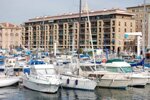 All that should now be bygones. In 2007, 32 clubs out of 36 signed a partnership with the MPM giving them a role of “citizen” and “activity”, and discharging them from “all concerns of maintenance and works” and… of the management of the spaces, which is now ensured by the two big clubs of the Old Port, the CNTL and the Nautique, delegated by the public authorities.
For passing amateur sailors, now only one office (04 91 73 93 63 or VHF channel 9) will allocate a free space, from the Pharo to the quai des Belges. This same number may also indicate the available mooring rings at the Frioul, the Pointe Rouge, the Estaque, and everywhere from La Ciotat to Sausset les Pins. A bit more time is needed for the small “calanques” (creeks): Carro, Cassis – Port Miou and the old basin of La Ciotat aren’t included in the system.
The project goes beyond the waters of the Old Port of Marseilles: the urban community covers 18 municipalities and 24 harbours, only six of which have a harbour master’s office. Some don’t have any toilets, showers, water or electricity. Others, in particular the Old Port – despite some recent efforts – are still a long way from the ambitious level of sanitary reception expected.
This is why, in liaison with the State, the Region, the administrative departments of Var and the Bouches du Rhône, the ADEME, and the Rhône-Mediterranean-Corsica Water Agency, 8.7 million Euros will be invested over seven or eight years in relation to a “charter of quality” regarding the management and order in the harbours, the compliance with “clean” standards, activities and the creation of new spaces.
More spaces! This is the promise the amateur sailors have been waiting for; they can now rest assured. Pleasure boating in general and coastal navigation in particular bring in enough money to ensure that these issues are at the heart of local authorities’ concerns. With 8,600 berths from Sausset to La Ciotat, the loss is estimated at 4,000. The Frioul is a part of the largest projects.
The sums are easy: five hundred additional reception places at €10/day (net profit) occupied 100 days/year bring in half a million. One thousand new spaces rented on an annual basis with a €1,000 margin bring in another million. Which, when calculated roughly, comes to some 1.5 million per year. The million invested each year will not be paid by the taxpayer.
In addition, when you think that each additional mooring ring means more work for dozens of nautical firms, and that a passing amateur sailor spends an average of €150 per day on land, the impact of the project on the local economic fabric is easy to see.
A last calculation as a riddle: if a large yacht brings in seven times more per linear metre of quay than your usual common or garden boat (MPM source), what will the policy be in terms of “large pleasure boating”?
If a small part of this money can help to preserve the fishing boats and other “pointus” (pointy-ended boats of the region) in the harbours, to grant discounts to those who spend their time and money to preserve the seascape, or to encourage coastal navigation out of season with winter prices, well…
- Christophe Naigeon


