Navigation
Méditerranée

Navigation
Diaporama
Navigation


Marseilles-Visit Marseilles by boat
here are some explanations on what you see when you enter the Old Port.
THE “BONNE MERE” WATCHING OVER THE TOWN
 From the open sea, it is the clearest landmark and a symbol too: Marseilles is in sight!
Notre Dame de la Garde was built between 1863 and 1893 on the former site of a 13th century chapel, also consecrated to the Virgin Mary. Like the Major cathedral that you discover almost at the same time, it is in a very rich Neo-Byzantine style. Topped with a 90m high belfry, it is overhung with an enormous 11m high Mother and Child covered in gold, by the Parisian goldsmith Charles Christofle.
The people of Marseilles call her the “Bonne Mère” (good mother). As protector of the town, people put ex-votos on her in the colours of the football team Olympique de Marseille…
Anecdote: at the end of the building work, a team of mules had to carry the 8t great bell to the top of the hill. Halfway up, the mules had had enough, so someone said: “We’d better fetch Macari”. This reputed contractor had an enormous pulley set up at the foot of the basilica, through which he put a very long rope, attaching one end to the cart and the other to the mules facing down the hill. As it was easier for these animals to pull while going down rather than when climbing up, the bell could be fitted. Since then, in Marseilles, whenever somebody is faced with a difficulty, they say: “Let’s fetch Macari.”
THE THREE “MAJORS”
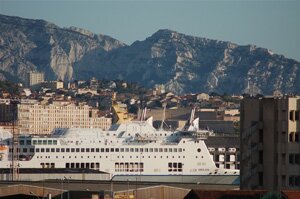
When you reach the outer harbour, it is the Major cathedral that attracts your attention on the port side, where the ferries are.
It’s the height of luxury! Between the Old Port and the “new”, the architect Léon Vaudoyer erected a building that looks more like a palace than a place of prayer. With its marble and porphyry, mosaics, domes, alternating green and white stones, it confirms Marseilles’ intention to be a gateway to the East.
It is as large as Saint Peter’s basilica in Rome, and can seat a congregation of up to three thousand people. The Prince and President Louis-Napoleon Bonaparte laid the first stone in 1852, and Pope Leo XIII made a basilica out of it in 1896.
The Major is 142 m long, its portico is 60m high and the nave 20 m, whereas the 17.70m diameter dome is 70m high, making it the sixth in the world.
To build it, two bays of the former Notre Dame cathedral there had to be demolished, as since the 5th century, several religious buildings had succeeded each other on this site. The work on the new one revealed the existence of a third early Christian church and a baptistery set up on the same site: thus we can talk about the cathedrals of Saint Mary Major.
PHARO FEET IN THE WATER
 A quick look to starboard and you will see the hill of the Pharo, the third building of the Napoleon III era, to which the Bourse and the Saint Charles station are added a bit further on.
On a visit to Marseilles in 1852, Louis Napoleon Bonaparte, still President of the French, decided to build a villa “right on the water’s edge” in Marseilles. This futuristic “marina” whose first stone was laid in 1858 never saw either the emperor nor the empress who, in the meantime, had been promoted. Eugenie gave it as a gift to the town.
It is not blindingly light or refined in its style, but its position on the hill over the harbour makes it an important part of the landscape, balancing out this part of the town.
After having housed the Faculty of Medicine, the Pharo now houses trade fairs and seminars and provides participants with a splendid view over the islands, harbours and the town.
SAINT JOHN OF THE SQUARE TOWER
Go past the Pharo’s cove and enter the entrance channel to the Old Port under the double authority of the Saint John and Saint Nicolas fortresses. On the port side, there’s the Saint John Fortress and its Fanal Tower, former command post of the Hospital Services of Saint John of Jerusalem at the end of the 13th century. Its Square Tower, attributed to King René and built in the 15th century, is included in the ramparts, raised in 1666 by the engineer Clerville, under the authority of Vauban and at the request of Louis XIV.
Nowadays the Fortress houses collections of which some reproductions decorate the pale pink façade. The town intends to create a new museum there, the MUCEM, which will fall within the “Cité de la Méditerranée” project. Although the Square Tower, open to the general public, provides an incomparable view over the harbour, it is also pleasant in the evening, to be gently rocked by the boat, while catching glimpses of the shadows against the walls, so sober by day, of lovers on romantic strolls in the town and offshore.
THE SAINT NICOLAS CITADEL
On the other side, a fortress signed by Vauban. Louis XIV, who apparently said “We have noticed that the people of Marseilles prize pretty buildings. We have decided to have our own at the entrance to this great harbour” also had the Saint Nicolas Fortress “The citadel of the people of Marseilles” built on the green lighthouse side, and completed in 1664. The aim was the same as that for the construction of the Saint John Fortress: to put an end to the uprising of the inhabitants of Marseilles who ridicule Royal authority. You will notice that the canons face towards the town …
In the Middle Ages, the site housed a small chapel founded between 1150 and 1228 and dedicated to Saint Nicolas; it belonged to the Saint Victor Abbey.
At the foot of it, at the level of the narrowest opening between the two fortresses, the Sénéchal de Provence ordered in 1322 that a wooden fence be fitted; at the end of this fence, a chain was to be fixed blocking the entrance to the harbour. It was reinforced gradually afterwards so that thirty years later, there were two actual mounds. It was also a period of major work around the Saint Nicolas chapel in order to create a wall-walk joining up with the harbour’s chain.
This system of defence was revealed to be completely useless in 1423 against the attack by King Alphonse V of Aragon. The town was plundered for three days by the people of Aragon, the Catalan galley ships having taken the Chapel from behind. As their trophy, they took with them the harbour’s chain which is now displayed in Spain, in the cathedral of Valencia.
SAINT LAURENT OF THE FISHERMEN
On the red beacon’s side, just above the boats of the Affaires Maritimes, is one of the purest buildings of the harbour. With a spire like the one at Collioure, it is the Saint Laurent church, built in the 12th century, the parish of fishermen and sailors. Particularly damaged by the destruction of the area in 1943, it has nevertheless maintained the beauty of its Romanesque architecture in pink limestone from Cap Couronne. Beside it, the Saint Catherine chapel was built in 1604, in late gothic style, unique in its kind in Marseilles.
SAINT VICTOR OF THE LEGION
Still towards starboard, just after the harbour master’s office and the CNTL, above the so-called Carénage basin, there is a church with a “clocher à peigne” (open bell-tower): the Saint Victor Abbey.
Legend has it that Victor, an officer of the Roman legions converted to Christianity, was tortured around 228 for having refused to offer up incense to Jupiter and for overturning the altar. Emperor Maximian ordered that he have a foot cut off, then be crushed by a millstone, before being beheaded with his evangelical fellows. Their bodies, thrown to the sea, were brought back by an angel and put in a small cave. Around 413, a monastery was founded in his honour.
After being destroyed by the Saracens, the church was rebuilt in the 11th century, then fortified by Urban V in the 14th century. The crypts contain remnants of the primitive basilica.
THE AUCTION HOUSE THEATRE
At number 30 Quai Rive Neuve, the former fish auction house has been a theatre since 1981, made famous by Roland Petit’s ballets. Its programming of events is well worth making sure you’re free one evening.
TOWN HALL AND FERRYBOAT
You are now in the second half of the dock. Marseilles’ town hall has a privileged place on the Old Port. You actually need to look at the whole ensemble to appreciate it: the building, a wonderful example of the 17th century Baroque architecture in Provence, the quai du Port, very wide here and which opens out into the Bassin d’Honneur where two superb historical sailing ships are moored, without forgetting the terminus of the ferryboat (the Cesar), made famous by Pagnol, set up in 1890, and which takes passengers across the dock to the Bar de la Marine.
The town hall escaped being destroyed along with the houses of the quai du Port at the end of the Second World War, which means that it now has pride of place alone between two recent high-rise blocks.


