Navigation
Méditerranée

Navigation
Diaporama
Navigation




Meze-Wines from the neighbouring diocese to the whole world
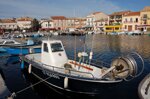
The current port in Mèze, built in 1709, had its activities increased tenfold thanks to the manufacture of brandy in the 18th and 19th centuries. The Argand brothers, from Geneva, opened Europe’s biggest distillery in Mèze, making the small port become a place of transit for wines and alcohols from all of the neighbouring dioceses to the whole world.
 It’s hard to imagine the quayside of this quiet Mèze port, full of barrels and run amok with shouts and noises of hammers hitting barrels, and yet this was the scene of Mèze in the 18th and 19th centuries. In 1709, Mèze was the leading port in Languedoc, a prosperous and industrial merchant town before that of Sète, which was not yet fully operational (built in 1666). At the time, vines shone on the Hérault plain, leading to the need to store and export.
Barrels of every kind. A real industry arose, directly linked to the vines, and in order to dispatch the wines and brandies, barrels, tuns (large capacity barrels of 50 to 300 hectolitres) and containers of all kinds had to be made. Cooper firms set up around the port from the start of the 18th century. These activities attracted a large labour force, making the town expand to 5,807 residents in 1886 of whom 391 worked in the cooperage industry.
 The arrival of the Argand brothers just before the French revolution increased production by ten, as these two physicists and chemists from Geneva set up Europe’s biggest distillery in Mèze. "In 1789, there were 20 cooper firms for 300 coopers and all of the related trades, manufacturing, storage, jobs on the port. The Argand brothers played a real driving role in the economy of Mèze and transformed this little port in to a place of transit for all of the neighbouring dioceses. " explains Guy Bastide, member of the cultural department of the local authorities in Mèze, with a keen interest in history. A multitude of trades were created, wine merchants, sales representatives, cellar masters, distillery workers, cartwrights, haulage contractors and hundreds of others. At the height of its expansion, the cooper firm employed 1,200 people.
From dawn until dusk, the workshop and port hummed like a hive, with workmen banging, adjusting and manufacturing "demi-muids" (150 litre containers) and "bordelaises" (230 litre containers) in a deafening din.
 Guy Bastide continues: "All of these products, as well as their mutual origin, the vine, had something in common: they were all being sent to national and international customers rather than to the neighbouring markets." This was illustrated in 1875 by the 600,000 hectolitres of brandy and spirits sent to the four corners of the world, from the port of Mèze. The shape of the barrels differed depending on the country to which they were going. For example: for trade operations with Brazil, white wine was sent in Portuguese Pipes (480 litres), half-pipes (240 litres), fifths (96 litres) and tenths (48 litres). Another example concerns the white and red wine for the Indies, which was sent in Dutch barrels with wide bar of 220 litres.
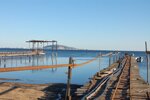 The people of Mèze also sent the wine and brandy to their colonies in the United States, South America, the West Indies and of course France. Mèze continued to thrive despite the phylloxera which decimated the vines in 1876, and the first world war, and then along came the decline with the considerable boom in renting barrels (instead of making them), and with the modernisation of the tools. In addition, all sorts of weird and wonderful barrels and containers invaded national trade from abroad, with tankers and oil-tankers dealing a heavy blow in the 1920s-30s. The cooperage industry moved to Sète, and the last coopers of Mèze disappeared after the second world war, leaving Mèze to return to water. Salty water, as the famous so-called Bouzigues oyster thrives in Mèze.


