Navigation
Méditerranée

Navigation
Diaporama
Navigation


Aigues-Mortes-it well and truly existed before Saint Louis.
Recent discoveries have shown that the site of Aigues-Mortes dates back to the 7th century B.C. But it was not until the 8th century that it was first mentioned in official documents. Archaeologists have also confirmed that there was a port on the actual location of the town at the end of the 12th century. Aigues-Mortes well and truly existed before it was made famous by King Louis IX
 As can be seen by some remnants of settlement from the 7th century B.C.: fragments of crockery and coins have been recently found on the first offshore bar. They are evidence of a Gallo-Roman presence and confirm an intense fishing and salt activity ("saunaison" in French, which means salt harvesting). Historians have also discovered an altar dedicated to Sylvain, the protector of forests and livestock, in the former Sylve Godesque massif. This clearly indicates the importance of breeding around the edge of the maritime pine forests which covered the region at that time. The trees provided the building wood and the resin for the caulker of Roman boats. Parcels of this splendid maritime pine forest can still be seen along the Saint Gilles Way.
But it was not until an 8th-century document that the name Aquœ Mortuœ, dead waters, was mentioned. An abbey was built on a stretch of isolated headland. It was called Insula Psalmodiana then Psalmodi, in reference to the psalmodies sung by the monks. Local tradition always referred to it as Saunosi, in reference to the salt-makes and salt which was the main currency during the Middle Ages.
Chapels are mentioned in 10th and 11th century deeds. Saint-Clément, Saint-Vincent and Sainte-Agathe, built from stone, wood and reeds can be found not far from Aigues-Mortes on a dead arm of the Rhone River..jpg)
Besides working in the fishing and salt industries, the inhabitants built rafts and boats and sailed on the lagoons that the alluvium from the Rhone had not blocked yet. Throughout ancient times and the Middle Ages, small boats of all kinds used the bays, lakes and that part of the Rhone River that was navigable. Numerous traces of small river ports and jetties, and berths clearly prove that boats sailed up to Saint-Gilles, Beaucaire or Arles. This was precisely how foreign goods were distributed in the area and how local products were exported.
And one of these ports was Eaux Mortes (Dead Waters). Several documents confirm that the port existed at the beginning of the 13th century, even at the end of the 12th century. But why have a port in this particular place? Probably because the layout of the land turned out to be an ideal protection from a capricious sea.
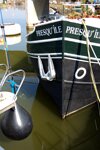 At that time, the site could not be reached by land as it can today. Aigues-Mortes was situated at the end of the Psalmodi lake – which is today the Salins du Midi salt marsh – which was sufficiently deep for the commercial boats of the time. The lake was linked to the "white waters" by a former arm of the Rhone River, the Vieil Canal. The boats were able to use this arm to gain access to the Baie du Repos (Bay of Rest), which was a magnificent roadstead protected by offshore bars in the process of formation next to what would later become Port Camargue and La Grande Motte and which did not at that time join up at the place where Grau du Roi would be built much later. It was from here finally that the boats joined the open sea.
Another advantage of Aigues-Mortes is that it is connected to Lake Maugio, in the heart of the inland waterways leading on the hand to the Narbonnaise and on the other to Saint-Gilles. Finally, it is located at the mouth of the one of the arms of the Rhone River from which it gained excellent access inland.
For a long time, Aigues-Mortes was a modest port, a transhipment out-port. But labour, dwellings and warehouses were needed to deal with the flow of traffic. In 1278, an artificial "grau" (passage) and the first transhipment quay were built between the Psalmodi Lake and the Baie du Repos, at La Peyrade, where the Mas Rouge is situated today. Vessels took this direct, embanked passage rather than the Vieil Canal which became silted up.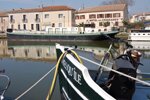
This initial port facility prefigured the future town, even though there was no tower or walls. In the 13th century, when Saint Louis wanted to provide the Kingdom with a Mediterranean port, he chose Aigues-Mortes. He obtained the land and the town by exchanging properties with the monks of Psalmodi and levied a tax on salt production to finance part of the works. He transformed Aigues-Mortes into a fortified town and port of departure for the pilgrims heading for the Holy Land.
- Source
Aigues-Mortes by Alain Albaric


