Navigation
Méditerranée

Navigation
Diaporama
Navigation



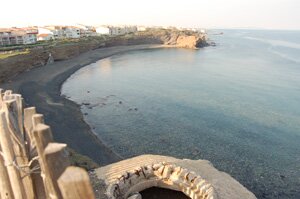
Agde-The massaliote city with a historic canal
The port of Agde, which was built in the 6th century B.C. by Greeks from Phocea, became a major commercial and fishing port. It was ranked as the second-largest port in the Mediterranean behind Marseilles. The construction of the Midi Canal in the 17th century increased its activities tenfold.
Wine, olives, oils and fish. These are some of the products that the Massaliotes (inhabitants of Massalia, former name of Marseilles) from Greece exported as early as the 6th century. The port of Agde rapidly became a prosperous commercial port. It was ranked as the second-largest port in the Mediterranean behind Marseilles. Nestling at the crossroads of the Hérault River and the sea, Agde was built on this strategic location which favoured trade and commercial exchanges, and offered the possibility of going further inland.
Agde developed its fishing activities on a parallel with its trade operations. Although free during the Greek period, the rights of local lords meant that it was controlled during the feudal system. The church made its own demands. It withheld taxes, the tithe or even the "pulment", which was an additional duty collected and which depended on the type of fish and place where it was caught. The fishing port became prosperous in the 13th century and reached a peak in the 17th.
The construction of the Midi Canal through the town of Agde from 1662 to 1680 represented a major event for the town. The father of this work of art – a 240-kilometre long canal running from Toulouse to Marseillan - Pierre-Paul Riquet, who was born in Béziers, placed Agde at the crossroads of the Canal, the Hérault River and the sea. The challenge was to join up the Mediterranean Sea and the Atlantic Ocean with a waterway fed by neighbouring rivers thanks to an ingenious system of channels. What a remarkable feat of civil engineering during the reign of Louis XIV! It has 328 structures: tunnels, bridges, lock basins, aqueducts… and is lined by 250,000 trees (45,000 in the 17th century).
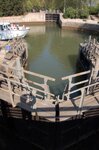 It should be noted that the variation in height from the seuil de Naurouze (Naurouze threshold) – the highest point between the two seas – and the Thau lake represents a stunning 189.084 metres. Riquet was able to solve the problem by using 48 locks. A lock is a device for raising and lowering boats between stretches of water of different levels using a system of gates and valves. The famous round lock, the first in the world when it was built, can be found in Agde.
Besides the outstanding technical features of the construction, the Midi Canal played a critical role in favouring communication, transport and economic development between the East and West, and between the sea and the ocean. The wine and cereal trade naturally contributed to the importance of the port of Agde.
From its construction to the beginning of the 20th century, the Midi Canal was used in particular by boatmen with large boats. They were continuously to be seen sailing through the South-West river basin before taking their boats up north towards Paris and Northern Europe via the Rhone.
The arrival of petrol engines and trains towards 1925 put an end to this type of sailing. The Canal is now mainly used by pleasure boats. Barges and penichette barges have replaced the sapines and coutrillons – these were very powerful, roughly-built, 30-metre long wooden boats which were specially designed for canals. At the same time, tartans (a small one-masted vessel with a large lateen sail and a foresail), bricks (small tonnage two-masted boats) and streamlined schooners could be seen in the port of Agde. As far as fishing was concerned, there were sapines and hoppers which were used to load and unload vessels.
The port of Sète superseded Agde in the 19th century due to recurrent silting up problems while the shipyards continued to expand.
Do not be afraid of being labelled as a freshwater sailor and sail up the Hérault via the Grau d’Agde. The town is well worth the trip.
- Marilyn Beaufour and Deborah Peucheret


