Navigation
Méditerranée

Navigation
Diaporama

Navigation




Collioure-Collioure victim of its success
Collioure received confirmation of its status as a commercial port in 673 by the Visigoth king, Wamba. Its activities progressively declined from the 15th century onwards when the continent of America was discovered. It was only in 1971 that the current port of refuge was built at Collioure following major flooding and the increasing number of boats at Collioure.
 The Greeks, the Phoenicians and the Romans coveted Collioure due to its opening on the Mediterranean and its two seashores which made it easier to defend. The Visigoth king, Wamba, lived on the site in 673 and named the town Caucoliberis, which means Port of Elne, confirming its importance as a commercial port.
From 981 on, the counts of Roussillon and the kings of Majorca developed and built a fortress at Collioure. Between 1276 and 1344, it became the summer residence for the kings of Majorca, which gave it a privileged status compared with the neighbouring towns.
Several crusades passed through Collioure and in particular the knights of the Templar order in 1207. Their visit did not go unnoticed and gave rise to the legend of the treasure of the knights of the Templar order. The Cistercians passed through in 1242 and the Dominicans in 1280. This was how Collioure lived at that time, spoilt by gods and kings.
Then the wind changed. The discovery of America in 1492 offered new perspectives for those in high places elsewhere than in the Mediterranean. Collioure began to decline
but found its salvation from its military location. Vauban, a military engineer under Louis XIV, arrived in Collioure. He altered the fortifications giving Collioure its current appearance. The Pyrenean Peace treaty of 1659 united the Roussillon region with the French crown once and for all. The treaty, which was signed by the Prime Ministers of Louis XIV, King of France and of Philippe IV of Spain, put an end to thirty years of Franco-Spanish war.
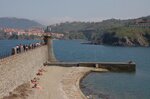 Collioure became a fortified town with a small fishing port after having excelled in ancient times and during the Middle Ages as one of the most strategic ports on the Mediterranean. The monuments that were at the origin of its fame and beauty are of particular interest: the Royal Castle, the key element of the defensive system. It is now classified as an historic monument. Secondly, the Fort Saint-Elme which was built in the 16th century by the Spanish Emperor Charles Quint and also the 13th-century Madeloc Tower. This former signal tower stands at a height of 652 metres. It was used in the past to watch over the sea and to ward off any attack. Finally, the Notre Dame des Anges church: its construction began in the Middle Ages. Its clock served as a beacon for the port.
After the traders and military forces, artists provided Collioure with its third economy boost. Life at Collioure is indissolubly linked to modern art. It was at the beginning of the 20th century that this small port began its long journey on the road to fame in the intellectual world.
Matisse settled here in 1905 and was closely followed by Derain. While Picasso and Braque launched the cubist movement not far from there at Céret, Collioure became the cradle of Fauvism and the meeting place for all the painters of the moment, before and after the First World War. Many artists flocked to the place and the small village became one of the most important artistic towns.
POLLUTER – PAYER…
Collioure is a natural port. Anchoring in the centre of the town to spend the evening and the night, and to see the sun rise over the port is a true privilege. But the number of visitors has forced the local authorities to take safety measures. With forty boats in the bay at the height of the summer, things had become very difficult: dumping of waste and black water, anchors which were getting caught in the sewage pipes… The use of the beach, which is also situated in the heart of the town, was continually on the verge of being closed down. Bathers are as much entitled to clean water as anybody else as they significantly contribute to the economic development of the commune.
At the risk of making enemies among our pleasure boating colleagues, we can say that Collioure had to impose a certain respect of the place because some of use had not acted as we should have done. Moorings are now limited to a number of buoys. Like in Port Miou where we destroyed all the Posidonia beds and elsewhere where we pulled out the corals… And we have to pay. In the same way as we pay to have our dogs’ dirt collected. I can hear you saying, polluter-payer?


