Navigation
Méditerranée

Navigation
Diaporama
Navigation



Côte bleue-A marvellous coastline saved in the nick of time
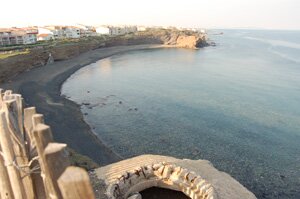
LA CÔTE BLEUE, or “THE BLUE COAST”, is a rocky, pine-covered peninsula overlooking the Mediterranean just to the west of Marseilles.
Even though work had begun on the first marinas towards the end of the 1970s, the local authorities decided to transform the Côte Bleue and its underwater coastline into a protected zone. By authorising a reasonable development of constructions and ports, they have created a site which is as beautiful as the calanques (deep narrow creeks) to the east of Marseilles.
 Carro, La Couronne, Sausset les Pins, Carry le Rouet, Ensuès La Redonne, Niolon… a string of names which stretch out along the shipping map, a few landmarks which are easy to locate such as the Carry building, the Sausset villa, the train viaducts from Marseilles to Miramas… The Côte Bleue extends from Cap Couronne to the Vesse calanque and from the Gulf of Fos to the edge of Marseilles.
It is also located right in the middle of two symbolic landmarks of civilisation: the four Lavéra chimneys to the west and the large blocks of flats in Marseilles to the east. The city and industry have trapped this thirty-kilometre long rocky coastline which slopes down gently when it reaches the Rhone delta becoming nothing more than a plunging shelf - a delight for windsurfers but the misfortune of captains whose wrecks are strewn across the sea floor.
Pollution hazards on the one hand, risks of concreting on the other, coupled with the threat of being overrun by tourists and fires everywhere, the Côte Bleue has, as far as possible, been able to avoid being destroyed. The Conservatoire du Littoral (Coastline Conservatory) has been buying land to protect it since 1980. With currently more than 3,300 hectares (33,000,000 sq. m), this represents the largest site of the Conservatory on mainland France. As far as the sea is concerned, a Sea Park covers underwater protection.
First of all there was an initial flow of Sunday tourists from Marseilles in the years that followed the end of the First World War: the opening of the Marseilles – Miramas line through tunnel driving and the construction of numerous viaducts paved the way for the arrival of tourists who visited the massif, its ports and calanques which were inhabited at that time by less than 3,000 people.
Then, in the 1970s, developments in pleasure boating incited promoters to build marinas around the calanques and the bays of the Côte Bleue, which are marvellous, natural shelters. A first access road to a future residential estate, 12 m in width and 3.5 km in length, was built but never used… Local authorities had the audacity to resist the tempting mermaids who made the sound of the gold from the sea ring out.
The Coast is undoubtedly blue. But in the spring, before July and August make nature fall into a long summer siesta, the large quantities of flowers transform the massif into a dazzling array of colours. You don’t have to be an experienced naturalist to appreciate the sight; the tiniest poet’s heart suffices.
Come back in April on the train which follows the coast better than any road does, or better still with your boat when the small fishing ports of the calanques in the north Bay of Marseilles finally have a mooring available for you, to see the gulls preparing their nests in the middle of the red poppies and marvel at the yellow and mauve bouquets which adorn the roughest rock.
- Christophe Naigeon
There are three types of vegetation on the massif. The first is found in arid and low or sparse garrigue zones. It is due to difficult environment conditions such as steep slopes, lack of soil or water, fire damage, etc. These zones take the shape of “leopard-skin” garrigue or brachiopod grass.
The second category includes zones of rosemary garrigue and Kermes oak garrigue, providing relatively low but continuous plant coverage, comprised of prickly and dense species such as the furze and a scrubby flowering plant known as cistes.
Finally, there is the wooded area that is essentially comprised of Aleppo pines and which is divided into adult pines or regeneration of young pines.
There are very small numbers of Holm oak trees on the massif. Its gradual disappearance represents an ecological loss.
On the other hand, the Mediterranean characteristics of the zone enable olive trees to survive for a long time after they have been abandoned and consequently continue to represent a major feature of the landscape. There are also almond and fig trees.
Due to the reduction in the abundance of the biological community in the area, the presence of animal species has dropped significantly. But there are nevertheless all the usual species including some rarer ones such as the Bonelli’s Eagle, the Great Eagle Owl, the falcon…
Source: The Coastline Conservatory


