Navigation
Méditerranée

Navigation
Diaporama
Navigation


Les Saintes Maries de la Mer-Flying saucers in Saintes Maries?
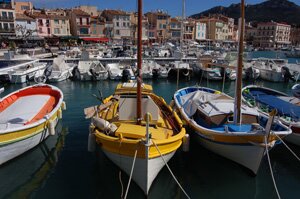
Port Gardian, the port in Saintes Maries de la Mer, sprang out of the ground in 1984, a godsend for the fishermen. Before that time, they were forced to pull their boats up onto the sand by themselves. Pierre Sellier, a fishing historian and native of Saintes Maries, gives us an account, with a pointed look back on a disappearing world.
"Imagine forty lateen sails outside, and some Grau du Roi sailboats. It was very pretty", remembers Sellier, a former fisherman, born in 1920 at Saintes Maries de la Mer. That would have been in the 1950s and '60s when fishing was at its height and still supported the families of Saintes Maries. A son and grandson of fishermen, Sellier began fishing at the age of 13, in 1933. "The school wanted nothing to do with me. I didn't know how to read or write, but I really liked arithmetic. I started fishing with my brothers. In the beginning, getting up at six in the morning, I got the boats ready. Essentially, I loaded the jute canvas bags filled with sand, which were used to ballast the boats. Sometimes thirty or so were needed for that to work", he explained.
From May to September, they would mostly bring back mackerel caught on a trawl line, under sail and under oar. It was only in the post-war period that a small 6hp motor could be purchased, "which was quite enough". That engine was undoubtedly a relief, but the biggest effort remained getting the small craft up onto the sand, in all sorts of weather–an exhausting task. As a result, the fishermen were delighted when they learned in 1984 that a marina was being created that would devote the far end–the part closest to the city–to them. Their pier allowed space for about twenty boats, provided that each was less than 10 meters in length. This was the case for all the boats, except one trawler, which would not remain.
According to Sellier, the authorities built the port in the wrong direction. ""Bad weather here always comes from the Southeast. And, well, the exit is oriented to the Southeast. What a blunder! They could have made it Southwest, but they claimed there was a risk of it sanding up. Well, at the present time [Ed: March 2008], a suction dredger pumps out the sand in the channel since 2 weeks."
However, it isn't the engineers' fault if fishing is on the wane. Year after year, the number of boats dwindles. Those that remain don't go out every day. Young people aren't taking up the torch, and the old fishing dynasties are dispersing.
Sellier has his own idea on whom to blame: it's the "new fishermen". "They buy nets, they hook up a 200hp motor; it's all very easy." The drop in fishery stocks? According to him, it's more a drop in energy: "The young people have no ‘get-up-and-go'. They say there are no more fish, but they won't find any staying at the dock!" As he explains, the fish are moving away from the shore due to pollution from the Rhône, which drains "all the chemicals people toss into it".
Will the inhabitants of Saintes Maries become nostalgic for that time before "progress"? It's possible. In any case, they have a sense of humour. Sellier saw another cause of pollution due to tourist development: in the summer, suntan oils form an oilslick that prevents the water from oxygenating, a tide burned by tanning!
Another great nugget of wisdom collected from a cafe terrace at the port: two local old-timers were watching the tourists moving about on electric scooters: "I thought that in the year 2000 we would see flying saucers everywhere. And look, we’ve only got idiots on scooters!" Saintes Maries villagers: looking backward, perhaps, but always observant.
- Marilyn Beaufour and Christophe Naigeon


