Navigation
Méditerranée

Navigation
Diaporama
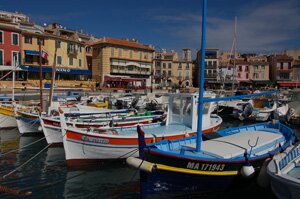
Navigation



Marseillan-Famous for its wines and spirits
The quayside of the current Marseillan harbour emerged in the 17th century as the Canal du Midi was built. In the 19th century, the harbour became the second largest in the Hérault region, thanks to the wine and aperitif industry. Remnants from the period can still be seen today, with the Noilly-Prat firm and the co-operative wine cellar.
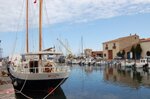 Located right at the far end of the Thau Lake, Marseillan is a pretty little harbour, lined with restaurants and former wine and spirit stores dating back to the 17th century. At this period, the harbour was well on the outskirts of the village, and the houses and buildings on the quayside made up a separate district around the harbour. Marseillan was located at the end of the lake where it was shallower than at Mèse or Bouzigues, which led to recurring and serious silting problems, meaning that the lake had to be dredged and cleaned out frequently in order to maintain its depth.
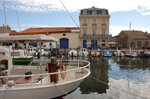 But Marseillan’s big break came with the decision to have the Canal du Midi flow into the Thau Lake, a small distance away from the harbour, thus bringing in significant commercial traffic.
Two centuries later: "The harbour experienced a wonderful boom in the 19th century, thanks to the wine and aperitif industry. The wine-producing area was producing a large quantity of wine that needed to be transported and exported. Marseillan therefore carried out significant work on the harbour in order to meet with demand", as Albert Arnaud, a local historian, explains. "The water level was filled up, enabling to gain huge expanses of land from the lake. Portions were allocated to merchants who built large wine and spirit stores and warehouses."
 Marseillan became the second biggest harbour in the Hérault region, after Sète. From the middle of the 19th century, the number of exports increased, as all of the surrounding towns and villages sent their precious beverage to Marseillan. The merchants bought it, and then transformed it according to the customer's request, diluting it to change the colour or alcohol content, leaving it as a wine or transforming it into aperitifs before sending it on. There was a real trend for spirits spreading in those days, and in Marseillan, produce manufactured included Quinquina, Noilly-Prat (which still exists today) and the aperitif Mignon, named after Mignon, the heroine of the famous eponymous opera by Ambrois Thomas (1811-1896).
 The Marseillan harbour was divided into two, with the rich on one side, and the less well-to-do on the other. On the right bank, only two important merchants shared the quayside, of whom one was Noilly-Prat. The owners built both their accommodation and their place of work in the same place.
The people of Marseillan called the most beautiful house of this quayside the "castle", which is now one of the restaurants of the Pourcel brothers. On the other bank of the harbour, smaller merchants were squashed in next to each other; families lived in the first-floor flats over the shops and offices on the ground floor. Behind them, the adjoining land belonged to the merchant along with the sheds and warehouses. Nowadays, restaurants have replaced the wine and spirit stores and several of the areas behind the buildings have become industrial wasteland, coveted by property developers.
The factories are gradually closing down, one after the other. Noilly-Prat has remained in Marseillan and organises visits for the general public throughout the year, during which you can admire the stills and tools and equipment of this period.
 The harbour’s activity reduced gradually until there was no longer any activity there in the fifties and sixties, and it was taken over by fishermen again.
With the development of pleasure boats in the seventies, Marseillan, at the end of the Canal du Midi, was in the best place to take advantage of the river tourism. Extension work generated two other lakes reserved for pleasure boats and houseboats, and the harbour now has 320 berths. Large barges regularly cast anchor there and the Convivencia festival of world music plays its last concert in Marseillan at the end of July. This original festival takes place on a barge which sails down the canal from Toulouse, providing audiences with free high-quality concerts in the harbours where it stops. Water and music together. It's well worth trying to plan a port of call when there's one of these concerts. If, of course, you can find a space in this very crowded harbour!

