Navigation
Méditerranée

Navigation
Diaporama
Navigation



Sainte Marie le Mer-A small and quiet place
The earliest reference to Sainte Marie la Mer goes back to the end of the 11th century. The village continued to exist, defended behind its ramparts, until the 19th century. An extension towards the sea was built during the 1950s where the Templars had decontaminated the marshes. Their work made it possible to develop a port and a seaside resort.

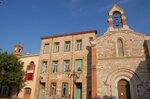 The village called Santa Maria de Pabirans takes its name from the church dedicated to Sainte Marie at the end of the 12th century. From then on, it was known as Sainte Marie la Mer. One single family had held the Seigneury since the 11th century but it changed hands at the end of the 12th century. The Seigneur Raymond of Canet (a village very close by) acquired Sainte Marie la Mer and requested permission from the King of Aragon, Pierre II to fortify it. In fact, there were hamlets all around the growing village of Canet and it seemed only right that a single feudal lord should be in control of them all.
Roussillon suffered attacks from the French until the Treaty of Corbeil (signed between France and Aragon in 1258) making Salses the border. At the same time, each village had to learn to defend itself and put up fortifications. That was the reason behind Raymond of Canet's request, in order to counter any possible attack by land. Attacks could come only from the land side because there were marshes along the shore, making it inaccessible in spite of the work done by the Templars (see the article on Saint Cyprien). That is how Sainte Marie la Mer came to have ramparts! The village remained in the possession of the Seigneurs de Canet and automatically became a dependency when the Vicomte de Canet came into being in 1322.
 Just like Argelès, Sainte Marie la Mer went through a series of upheavals linked to its geographical position right on the Franco-Spanish border (see the article on Argelès). In 1462, Catalonia came into conflict with Aragon and, with the help of France, Jean II of Aragon tried to conquer his own lands by military force. The inhabitants helped the Vicomte de Canet fight against the invaders, but their efforts proved to be insufficient. The town was under occupation from 1475 to 1493. Then a new situation arose: in 1493 Charles XII of France handed over the Comté du Roussillon to Ferdinand II of Aragon. But Sainte Marie la Mer was a very long way from his centre of power in Madrid. The king abandoned the village to its fate until 1648. Despite the Treaty of the Pyrenees, which put an end to the war between France and Spain in 1659, the inhabitants of Sainte Marie la Mer suffered Spanish attacks during the 1793 war.
In the 19th century, the ramparts which had resisted everything were finally demolished because of urban development which was already, even at that time, going at a steady pace.
 The extension stretched to the east towards the sea with the creation of a town on the beach where the marshes had been decontaminated. The Templars had already carried out a major part of this work during the 13th century when they drained the Salanque marshland. But there was still one section they had been unable to conquer, the final piece of land next to the sea. The seaside resort really came into being during the 1950s. In Sainte Marie la Mer you can see the classic development plan for the emergence of seaside towns. First of all, a few fishermen built wooden huts to store their equipment. Some of them set up residence there. Then sea-bathing became fashionable, and after the second world war, municipalities began building houses close to the beaches to accommodate this influx of tourists.
But over the years, Sainte Marie la Mer has succeeded in retaining a family atmosphere on a human scale, whereas other resorts have opted for a more commercial model. The little houses built at the beginning of the 20th century are still standing. You will not find any high-rise buildings or night clubs here. The municipality gears most of its activities to children, making this a place where you can enjoy a holiday far from the usual crowds.
But it is still a really lovely 500-mooring marina in a natural setting. Boats between 4 and 12 metres long can berth on the 8 floating pontoons. If you enjoy a quiet night on board, this is a stopping place you should not miss.


