Navigation
Méditerranée

Navigation
Diaporama
Navigation



Sete-29 July 1666: The first stone of the Saint Louis Quay
 It all began on 29 July 1666, when the first stone was laid for what would become the foundation for the port of Sète: the Saint Louis Quay. The king wanted to make the event very visible and what we would today call a marketing and public relations campaign was launched with great skill.
The idea was very simple: given that this port was intended to save commerce in Languedoc by creating a safe refuge for boats during heavy storms, as well as protection against pirates and foreign incursions, the "target" of the communication operation was logically the local merchants, the potential users and the natural disseminators of news.
Each year in July, a huge fair was held in Beaucaire "habitually visited by merchants and traders from nearly all countries". So it was decided to take advantage of this fact and to make these visitors come so that they could see for themselves that there would soon be "an easy and safe port in a location previously considered inaccessible". The idea was that they "would carry the news back to their home countries".
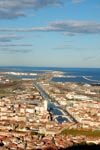 The organizer of the ceremony, the Intendant of Languedoc, spared no effort: in just three weeks, he had an artificial town built of wood and painted canvas in trompe l’œil, and a church dedicated to Saint Louis, the patron saint of the port, was hurriedly built at the mouth of the future canal.
From there, a kind of avenue was built, lined with buildings to receive famous people from the entire region and covered with greenery to keep the nobles cool and shaded during the high-summer heat.
Hundreds of caterers, cooks, publicans, and vendors of fruit, lemonade and "ice liqueurs" arrived to make sure that the visitors were well looked-after and fed.
On 29 July, Lake Thau was covered with boats while, on the roads, thousands of carts, calèches, hand carts and people on foot thronged towards the stage set/city.
Since there were not yet any bridges, much of the crowd had to wade across to the Île Singulière. The bishop of Montpellier celebrated a high mass and the first stone was laid. Hewn from Mount Agde, it was carved with medallions.
As described by Jean Sagnes in the "History of Sète" (published by Privat), while the officials moved this large stone, more or less satisfactorily, and the shoreline was far from stable, «artillery, chests, guns, musketry, trumpets, drums and cries of 'Long Live the King' ricocheted off the surrounding mountains».
 And so it was a grand celebration of which news spread far and wide. "To the city and to the world", the new port of Sète was now part of the commercial landscape of southern Europe. The operation was a success.
The opening of a safe port at this location was associated with another project, even more ambitious and having enormous consequences, that gradually took shape: Pierre-Paul Riquet, who hailed from Beziers, attempted to obtain authorization from Colbert to dig the Midi Canal which would cross Languedoc and would connect the Atlantic to the Mediterranean.
In the same year that the first stone was laid for the Saint Louis Quay, Riquet finally obtained the means necessary to begin work on a first section. Originally, the canal was meant to connect the Mediterranean to the narrows at La Nouvelle. But the beginning of construction of the Port of Sète meant that changes were made to these plans. Lake Thau became the natural mouth of the canal because a modern port ensured a connection to the sea. And so it is that mere stones change the course of rivers...


