Navigation
Méditerranée

Navigation
Diaporama
Navigation


Sete-Our island is singular our port must remain plural
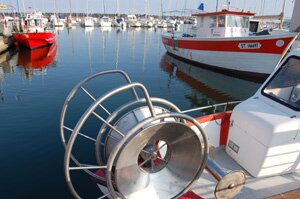
 Sète is unique. For a coastal sailor, accustomed to small, friendly ports or to large marinas, arriving at Sète is a new experience. Coming from the sea, you will have already seen the freighters anchored one or two miles from it, on seabeds fifteen meters shallower than here. If you entered via the wider channel to the east, you sailed around an oil tanker moored to the giant buoys, the "floating camemberts". If you took the small channel to the west around 3 pm, the fleet of trawlers hurrying to clock in at the auction has caught up to you... and, in the docks, you passed a ferry boat for North Africa, and a gleaming passenger liner, like the Love Boat maybe some war ships on a manoeuvre. Not to mention the "sapinous", the Thau shellfish farmers’ crafts, which pass at top speed (undoubtedly to catch an oyster escaping from the beds!), tugboats looking like sturdy, squat brutes, and the tourist contraptions for visiting the port resembling comical water striders. The only vessel you won't see in Sète is an aircraft carrier—you'll have to go to Toulon for that. Eventually, you found a spot at the foot of the lighthouse; you could then spend the evening watching all of these vessels work, pass each other, and stir up the water.
You will find a bit of this in Port Vendres or Port la Nouvelle, but at a much smaller scale. In Marseilles, which has everything, only larger—(except for fishing, well!)—the various kinds of marine craft don't mix. Ferries go here, freighters go there, liners over there, and yachts, at home among all of them, go in the Old Port. There is no nautical mixing in this cosmopolitan city. Conversely this mixture is the essence itself and the sin-gu-lar soul of the port of Sète. As we said, Sète is plural.
 But it does have a few drawbacks—why hide them? For example, the bottles, plastic bags, and pieces of polystyrene cases that float in the swill accumulated at the far end of the marina. Or the swell that rises around three in the morning when the fishermen leave, sometimes making masts, VHF antennas and wind vanes knock together! And for the fishermen, aren't those pleasure-boaters a nuisance, who, on the pretext that they've taken out their sails, believe they have priority over a trawler, which they didn't bother to see was pulling a one-kilometre trawl net, or who didn’t bother learning the rule about letting the less manoeuvrable vessel pass! Or who fail to understand that after twelve hours working on the sea—in all kinds of weather—it is necessary to arrive first at the auction in order to derive the best price for one's pains?
Certainly, election campaigns and institutional fights, economic arm-wrestling and quarrels between individuals, has and will again give us the sudden desire—for our own good—to separate, confront each other, and to divide and rule. There would be abundant reasons to do so: pollution, congestion, difficult cohabitation, ambition for the "top of the line", modernisation, rationalisation, savings, compliance with standards, etc. When the plans of the port are taken as the Gospel, there is always some reason to say that other people must give up their place.
 Of course, the commercial port is excluded from the game of "king of the hill". No one has yet considered changing everyone’s place to make Sète the world's largest marina, from the railroad station to Saint Louis lighthouse, and from the auction to Frontignan! But they have done so for the fishing port. The prospect of the old port filled in by a forest of masts, with the auction converted into a souvenir store, and the Royal Canal as an expo of the major brands in water sports, wouldn't just be ugly, it would also go against every trend in town planning, tourism, and economics. La Ciotat, Marseilles, Palavas—Mediterranean ports of every size have understood the importance of preserving the cohabitation of fishing and pleasure boats, of old sailing ships and high-tech yachts, with the blended odours of the fish, the wood, epoxy, and suntan oil.
Instead, let us learn to live together, in the port as in the city, just as in life. Let the pleasure sailors dock head to foot, waste less freshwater, monitor the regurgitations from their tanks, control their black water, choose their antifouling agents better, and empty their trash bins where they should. Let the fishermen slow down for the last (or first) quarter-mile, and keep track of their packing boxes and discharge of diesel fuel. Let the oyster farmers not view themselves as if in an offshore competition. And let line fishermen stop throwing cans everywhere and peeing—or worse—on the auction dock. It's not very complicated.
Although it is undoubtedly true that, because it is so simple, it is even harder to understand.
- Christophe Naigeon
-


